
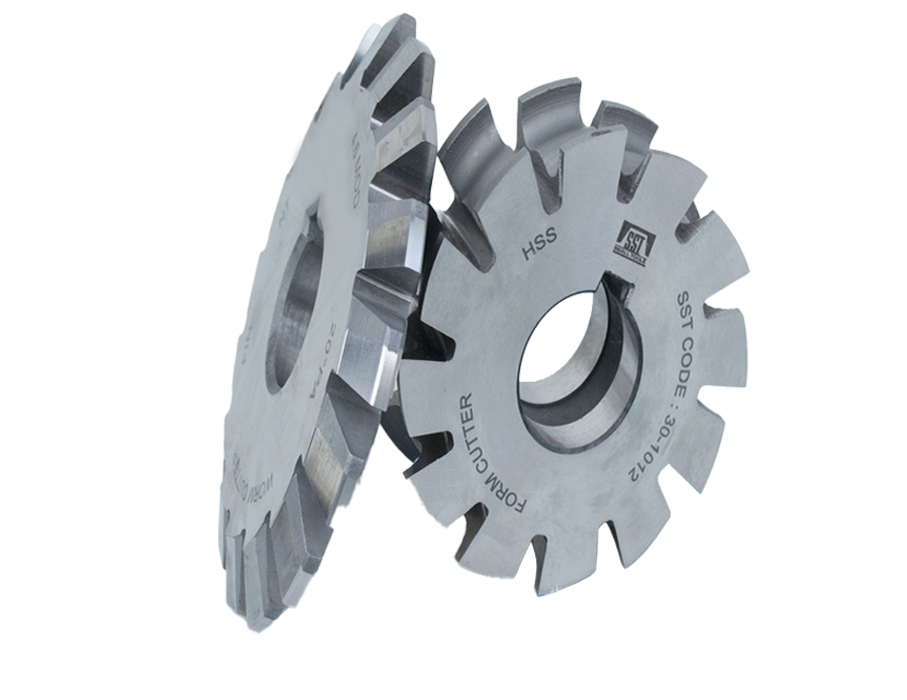
Milling cutters are rotating cutting tools that remove material from a workpiece on a milling machine or machining center. The metal comes off either through the cutter’s movement along a programmed path or through the cutter’s own shape, which is copied into the part. They are usually made from high-speed steel (HSS) or carbide, and they are used to produce flat surfaces, slots, pockets, contours and complex 3D forms.
Common types of milling cutters
Cutters come in many shapes and sizes. These are the ones most shops use:
- Slab mill: A wide cutter with teeth along its periphery, used to remove a lot of material from flat surfaces. It is common on horizontal milling machines and in gang milling setups, though indexable carbide face mills often replace it today.
- Roughing end mill: It has a wavy, serrated tooth form along its sides. The serrations break the chips into small pieces, so it removes a large volume of stock quickly. This leaves a rough finish, so a finishing pass follows. Machinists often call it a ripper cutter.
- End mill: Its cutting edges are on both the end and the sides, so it can cut slots, pockets and profiles. It can work at a set depth in vertical or horizontal directions. (A face mill is a separate tool, used mainly to machine large flat surfaces.)
- Ball nose cutter: It looks like a slot drill but has a hemispherical tip. It is the standard choice for 3D contoured surfaces, and it can also add a radius to internal corners, which lowers stress concentration where two surfaces meet at a right angle.
- Side and face cutter: It has teeth on the sides and around the circumference. It comes in many diameters and widths depending on the job, and it is one of the earliest milling cutter designs, dating to the nineteenth century.
- Hollow mill: A pipe-like tool with thick walls and cutting teeth on the inside surface. It is mainly used on screw machines to machine the outside of round bar stock.
What milling cutters are used for
Milling is one of the most widely used machining processes, especially where parts need tight tolerances. Machine shops and metalworking plants use cutters for slotting, profiling, drilling, thread milling and routing. They work on metals, plastics and wood.
Advantages of milling cutters
- Repeatable production: CNC control lets a machine run the same program on many parts with very little operator input.
- Flexible operations: One machine can perform several operations, and changing the program changes the part.
- Fewer errors: Computer-controlled toolpaths reduce the mistakes that come with manual setups.
- Accurate cuts and good finish: The right cutter and settings hold close tolerances and leave a clean surface.
- Customization: Cutters can be made to special profiles for custom parts.
- Multiple parts per setup: Several workpieces can be held and cut in one cycle.
- Cost efficiency: Faster cycle times and less rework lower the cost per part.
Conclusion
Milling cutters let shops shape parts accurately and adapt quickly to different jobs. Choosing the right cutter type, material and coating for the workpiece is what gives good results at a reasonable cost.