
An excavator working in hard clay or a crane lifting precast slabs puts enormous torque through its drivetrain every hour. The gears inside the gearbox, swing drive, and final drive take most of that punishment. Whether they last 10,000 hours or fail at 4,000 often depends on decisions made long before the machine reaches a job site, starting with the tools used to cut those gears.
Why gear accuracy matters in heavy equipment
Gear teeth transmit load through a small contact patch. If the tooth profile, lead, or spacing is slightly off, that load concentrates on one edge of the tooth instead of spreading across the face. The results show up in the field as:
- Pitting and micropitting on the tooth flanks
- Tooth root cracks from bending fatigue
- Extra noise and vibration, which loosen fasteners and stress bearings
- Wasted power from poor meshing, and higher fuel use over time
- Earlier overhauls and unplanned downtime
Construction gears are also typically made from case-hardening alloy steels such as 8620, 20MnCr5, or 18CrNiMo7-6. These are heat-treated after cutting, and heat treatment can distort the teeth slightly. That is why the cutting stage has to be accurate and predictable before the part ever goes into the furnace.
The main gear cutting tools and where they fit
No single tool does everything. Shops choose based on gear type, size, batch volume, and required accuracy.
Gear hobs are the workhorse for external spur and helical gears. Hobbing is continuous and fast, which makes it the usual choice for medium to high volumes.
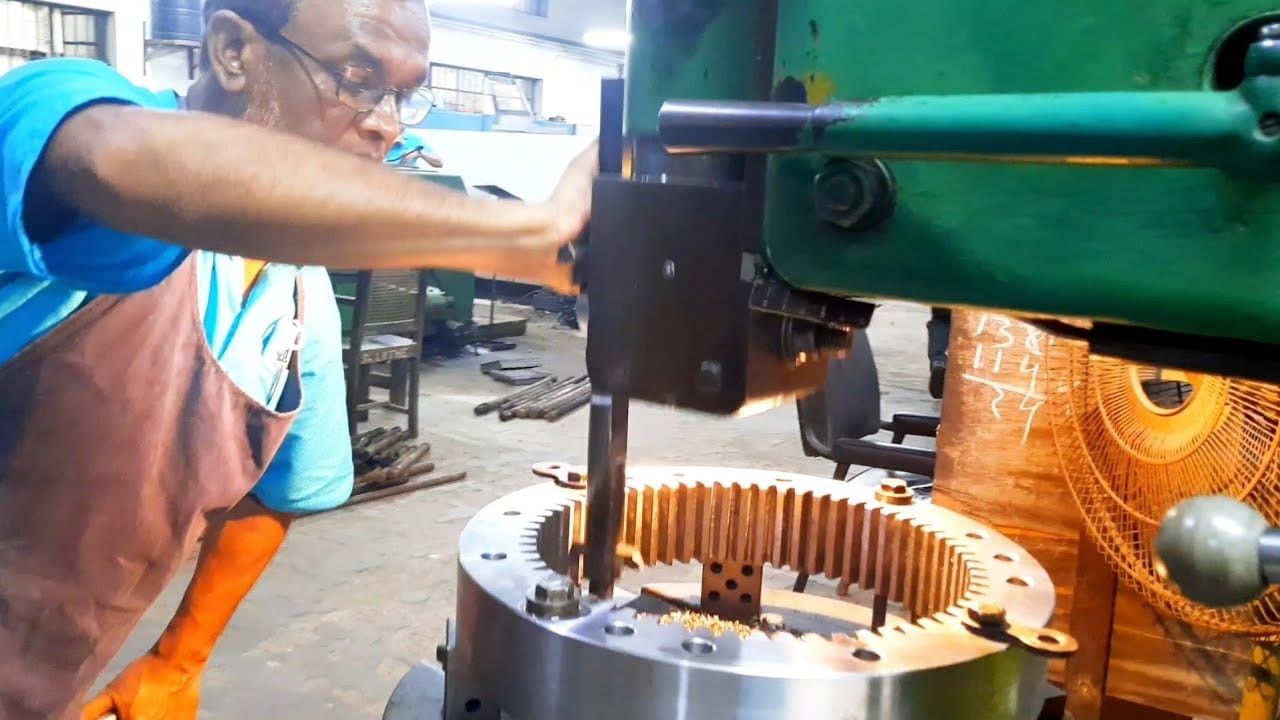
Shaper cutters handle internal gears, clustered gears, and teeth next to a shoulder, where a hob cannot reach.
Broaches cut internal splines and keyways in a single pass. They are very productive but tied to one profile.
Form milling cutters suit large-module gears, repair work and low-volume jobs, often on big gears used in swing drives.
Grinding wheels and tools finish hardened gears. Grinding corrects the distortion left by heat treatment and reaches the tighter accuracy classes (ISO, DIN or AGMA) that heavy-duty transmissions need.
What good tooling changes on the shop floor
Profile and surface finish. A sharp, well-made hob produces consistent tooth form and a cleaner surface. A smoother flank means less friction at the mesh and better lubricant film, which reduces wear.
Tool life and repeatability. Substrate and coating matter here. Powder-metallurgy high-speed steel and carbide hobs, paired with coatings such as TiAlN or AlCrN, can run at higher cutting speeds and hold their edge longer. Fewer tool changes mean more consistent parts across a batch.
Even load distribution. Accurate lead and profile mean the teeth share the load properly. That matters most in machines that see shock loads, such as breakers, buckets hitting rock, and swing motions under heavy slabs.
Less rework and scrap. Getting the geometry right at the cutting stage reduces the amount of stock that has to be removed in grinding, which saves time and cost.
The shift toward CNC and automation
Modern gear production is mostly CNC-driven. Machines control hob shift, feed and synchronization automatically, so the first part and the thousandth part in a run are closer to identical. Inspection has moved the same way, with gear measuring machines checking profile, lead, pitch and runout, and feeding corrections back into the process.
Tool suppliers have moved with this. Better carbide grades, improved coatings and optimized tooth geometry now let manufacturers cut faster without giving up accuracy. For an equipment OEM, working closely with a gear cutting tool supplier on tool design and regrinding schedules is often as important as the machine itself.
Choosing tooling for construction-grade gears
If you are sourcing tools for this kind of work, a few practical questions help:
- What accuracy class does the finished gear need, and will it be ground after heat treatment?
- What is the module and material, and is the part case hardened?
- What is the batch size, and does it justify a dedicated hob or a more flexible setup?
- Does the supplier offer regrinding and recoating, and can they support you with tool-life data?
Bottom line
A multi-million-dollar excavator is only as dependable as the gears in its drivetrain, and those gears are only as good as the process and tooling behind them. Accurate cutting reduces vibration, spreads load properly and extends service life. As construction equipment gets more powerful and customers expect less downtime, the tooling behind each gear matters more, not less.