
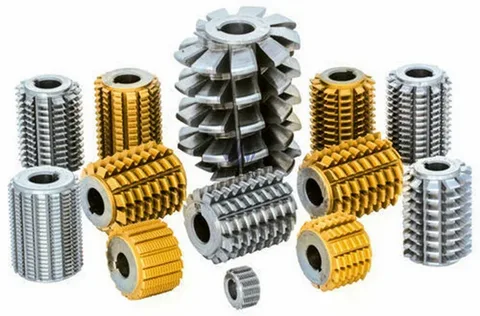
Choosing between a single-start and a multi-start hob changes your cycle time, your gear quality and your tooling cost. The right choice depends on what the gear has to do, not on which hob cuts fastest. This guide covers how each type works, where they differ in speed and accuracy, and how to pick one for a given job.
What Is a Single-Start Hob?
A single-start hob has one continuous thread wrapped around its body, like a single-thread screw. Each hob revolution advances the workpiece by one tooth. This simple geometry produces the most accurate tooth form, which is why most precision work relies on single-start gear hob cutters.
What Is a Multi-Start Hob?
A multi-start hob, sometimes called a multiple start hob, has two or more threads running side by side. Each revolution advances the workpiece by as many teeth as the hob has starts. The double-start hob and the triple-start hob are the most common, and they are chosen mainly for faster stock removal.
How the Number of Starts Affects Hobbing Speed and Feed
In gear hobbing, the work table turns in proportion to the number of starts on the hob. The relationship is simple:
Table speed (rpm) = hob speed (rpm) × number of starts ÷ teeth on the gear
Take a 40-tooth gear and a hob running at 120 rpm. A single-start hob turns the table at 3 rpm. A double-start hob turns it at 6 rpm. If the feed per work revolution stays the same, the table covers the cut in half the time, so hobbing time roughly halves.
You rarely get the full saving on the shop floor. The machine has to drive the table twice as fast, and not every machine can. The feed per work revolution also often has to come down to keep the chip load safe. So the gain in hobbing cycle time is usually smaller than the number of starts suggests.
Accuracy Differences: Profile, Lead and Pitch Errors
Single-start hobs have a smaller lead angle, so profile deviation is lower and the surface finish is better. Multi-start hobs have a larger lead angle, and every thread must match the others exactly. Even small differences between threads appear on the gear as pitch, lead and profile errors. For this reason multi-start hobs usually reach a slightly coarser accuracy grade.
Lead angle is what drives this. It depends on the number of starts, the module and the hob’s pitch diameter: sin(lead angle) = starts × module ÷ hob pitch diameter. More starts means a steeper thread, and a steeper thread finds it harder to generate a clean involute, so profile error goes up.
Hob Accuracy Classes: AAA, AA, A, B and C
Hobs are graded by accuracy class under standards such as DIN 3968 and, for single-start hobs, ISO 4468. The classes run from AAA, the tightest, down through AA, A, B, C and D. As a rough guide:
- AAA and AA: finishing and pre-shave hobbing, and gears for automotive and aerospace work. These are almost always single-start.
- A: general precision gears and power transmission work.
- B and C: roughing, commercial gears, and agricultural and general machinery. Most multi-start hobs sit in this range.
Comparison Table
| Factor | Single-Start Hob | Multi-Start Hob |
| Productivity | Standard | Higher, rises with the number of starts |
| Accuracy | High | Moderate |
| Lead angle | Smaller | Larger |
| Surface finish | Better | Slightly coarser |
| Machine demand | Normal table speed | Higher table speed |
| Resharpening | Simple, wear is even | Needs precise grinding to keep threads identical |
| Best use | Finishing, pre-shave | Roughing, high volume |
When to Use a Single-Start Hob
Choose a single-start hob when accuracy matters more than speed. It suits finishing passes, pre-shave hobbing, and gears for automotive and aerospace applications where noise and smooth transmission are critical. A pre-shave hob is almost always single-start for this reason.
When to Use a Multi-Start Hob
A multi-start hob suits roughing and high-volume production. It works well for lower-grade gears in agricultural and general machinery, where cycle time and cost per part matter more than top accuracy. Many shops also use one to rough out the teeth before a single-start finishing pass.
Effect on Tool Life, Wear and Resharpening
A multi-start hob finishes a batch sooner, but uneven wear between its threads quickly degrades gear accuracy. Resharpening has to keep every thread identical, which takes precise grinding. Single-start hobs wear evenly, are simpler to resharpen, and can be shifted axially to spread wear across more teeth.
Machine and Workpiece Requirements
Multi-start hobbing needs a hobbing machine with enough table speed and rigidity. The number of starts should also share no common factor with the workpiece tooth count. If it does, the same hob threads keep cutting the same teeth, and indexing errors build up. Large-module gears and very low tooth counts are generally better suited to single-start hobs.
How to Choose the Right Hob for Your Application
Start with the accuracy class the gear requires, then look at batch size and machine capability. If the gear needs high accuracy, choose single-start. If volume drives the job, use multi-start for roughing and follow with a single-start finishing pass.
The hob is not always the right tool. For internal teeth or gears close to a shoulder, gear shaper cutters are often the better process. For worm wheels and non-standard tooth forms, look at worm hobs and custom profile cutters instead.
From Our Shop Floor
One of our customers was cutting a 45-tooth, 3 module spur gear in 20MnCr5 for a tractor gearbox. Every gear went through a single-start Class B hob, and hobbing time was about 6.5 minutes per piece. The batch was large and the gear grade was not demanding, so the cycle time was the real problem.
We moved the roughing pass to a double-start hob and kept a single-start Class A hob for the finishing pass. The tooth count is odd, so the two threads shared no common factor with the gear. Hobbing time came down to about 4.8 minutes, and the gears stayed within the customer’s required grade. The double-start hob did need regrinding a little sooner, which we expected, and we kept its thread-to-thread accuracy tight at resharpening.
S.S. Tools has been making gear cutting tools in Patiala for over 30 years. If you are unsure which hob suits your gear, send the drawing or specification to info@sstools.net and we will recommend one.
Frequently Asked Questions
Does a multi-start hob always cut faster?
Usually, but not always. A multi-start hob generates more teeth per revolution, so cycle time drops. But the saving is often smaller than the number of starts suggests, because the feed may have to be reduced and the machine may reach its table speed limit first.
Is a single-start hob more accurate?
Yes. Its lower lead angle and single thread give better profile, lead and pitch accuracy.
Can multi-start hobs be used for finishing?
Only for lower-grade gears. High-accuracy finishing is better done with a single-start hob.
Which is better for pre-shave hobbing?
A single-start hob, since shaving depends on a precise, consistent tooth form.
Can I use a double-start hob on any gear?
Check the tooth count first. A gear with an even number of teeth shares a common factor of 2 with a double-start hob, so the same thread keeps cutting the same teeth and any difference between threads turns into indexing error. An odd tooth count avoids this.